
Modern distributed systems don’t fail in obvious ways. They fail quietly, partially, and repeatedly. A request might succeed on the server side but fail on the client side. A message might be processed but never acknowledged. A timeout might occur after the most expensive part of the work is already done. And every one of these situations creates the same dangerous outcome: the system cannot tell whether it should repeat the operation or not.
This is where most production bugs come from. Not from broken logic, but from repeated logic that was never meant to run twice.
Idempotency exists to solve exactly this problem. It is not about performance or optimization. It is about correctness under uncertainty. Once you move into real distributed systems — payments, queues, APIs, background jobs — you are no longer writing code that runs once. You are writing code that may run multiple times for a single user action, whether you want it to or not.

The hidden problem behind retries
A request timeout is one of the most misleading events in system design. From the client’s perspective, a timeout looks like failure. From the server’s perspective, it might be success. The request could have been fully processed, partially processed, or never reached the business logic at all. There is no reliable way to infer which state actually happened unless you explicitly design for it.
This becomes critical in systems like payments or order processing. Imagine a user submits a payment request. The server processes it successfully, charges the card, writes to the database, and commits the transaction. But before the response reaches the client, the connection drops. The client retries. Now the system sees the same request again, but it has no memory of what happened before unless it was deliberately stored.
Without idempotency, the system repeats the charge. From a business perspective, nothing “went wrong” in the code. Every execution succeeded exactly as written. The failure is in the assumption that requests are unique events.
Why distributed systems never reach exactly-once execution
There is a long-standing theoretical result in distributed systems showing that perfect coordination over unreliable networks is impossible. In practice, this means you cannot guarantee that a request will be executed exactly once. Not at the application level, not at the network level, and not even with retries, acknowledgments, or confirmations.
Every system that claims “exactly-once” semantics is actually hiding a combination of at-least-once delivery and application-level deduplication. The infrastructure will happily send the same message multiple times. The only thing preventing duplication is whether your application can recognize that it has already handled the request.
This shifts responsibility away from infrastructure and places it directly on application design. Instead of asking “how do I prevent retries?”, the correct question becomes “what happens if retries always occur?”
Idempotency as a design contract
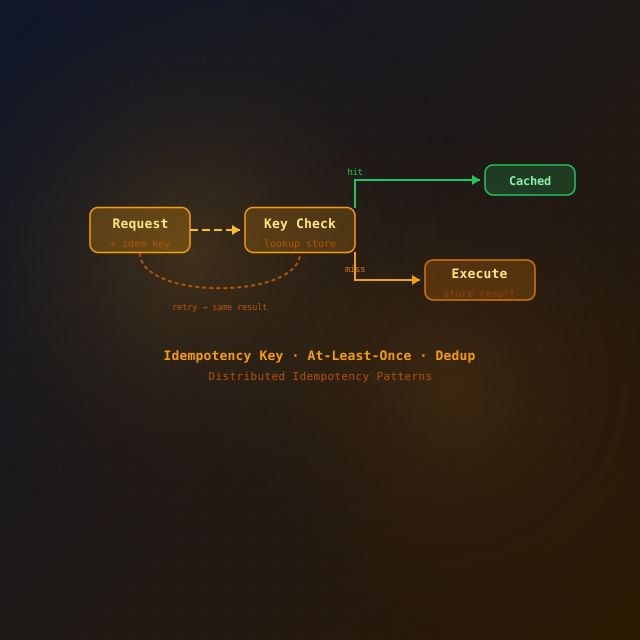
At its core, idempotency is not a technical trick. It is a contract between the client and the server. The client promises to attach a unique identifier to every operation. The server promises that if it sees the same identifier again, it will not re-execute the operation but instead return the original result.
This simple idea fundamentally changes how systems behave under failure. Instead of treating retries as exceptions, they become normal behavior. Instead of trying to detect duplicates through heuristics, the system explicitly records intent.
The key insight is that the system does not try to determine whether a request is new. It assumes every request might already exist and uses a deterministic lookup to decide what to do next.
The role of the database as the source of truth
The most reliable way to implement idempotency is to use the database as the authoritative store of request state. Not cache, not memory, not distributed locks, but the database itself.
The reason is simple: only the database provides atomicity guarantees strong enough to survive concurrent retries. When two identical requests arrive at the same time, the system must ensure that only one of them proceeds into the business logic. This cannot be achieved with a check-and-set approach that spans multiple operations, because between the check and the set, another request can slip in and execute the same logic.
The correct approach is to rely on a unique constraint that forces mutual exclusion at the storage level. The first request inserts the idempotency key and proceeds. Any concurrent request attempting the same insert fails immediately and is redirected to the stored result. This transforms a race condition into a deterministic outcome.
What makes this powerful is that the database becomes the arbiter of truth. The application no longer decides whether a request is duplicate. The database enforces it.
Why caching systems fail in subtle ways
At first glance, Redis or similar systems seem like a natural fit for idempotency. They are fast, simple, and support atomic operations like SETNX. However, the problem is not speed — it is consistency across multiple systems.
A typical failure occurs when the system sets a key in Redis before processing the request, then performs the business logic in a separate database transaction. If the service crashes after setting the key but before completing the transaction, the system believes the request has been processed, even though it has not. If it crashes the other way around, the request is processed but not recorded. Both cases lead to inconsistent state.
The root issue is that Redis and the database do not share a transaction boundary. Without a single atomic commit, the system is always exposed to a window of inconsistency. This is why production-grade idempotency always pushes the key into the same transactional context as the business operation.
The transactional outbox and cross-system consistency
Even if request handling is idempotent, system-level consistency is still fragile when events are involved. After a successful database commit, systems often publish messages to external brokers like Kafka. This introduces another failure window: the database commit may succeed, but the message publish may fail.
If that happens, downstream systems never see the event, even though the state change exists in the database. If the publish is retried blindly, duplicate events may be sent.
The transactional outbox pattern solves this by making event publishing part of the same database transaction as the business operation. Instead of sending messages directly, the system writes them into an outbox table. A background worker then reads this table and publishes events asynchronously.
The key benefit is that event creation becomes as reliable as the database itself. If the transaction commits, the event exists. If it does not, the event does not exist. Publishing becomes a separate concern that can safely retry without affecting correctness.
Why consumers must also assume duplication
Even with perfect idempotent producers, consumers cannot assume uniqueness. Message brokers typically guarantee at-least-once delivery, not exactly-once delivery. This means consumers must be designed with the assumption that they will receive the same message multiple times.
The standard approach is to track processed events using a persistent store keyed by a business identifier. When a message arrives, the system checks whether it has already processed that event. If it has, it skips execution. If not, it processes the event and records it as completed.
This makes duplicates harmless. The system does not attempt to avoid receiving duplicates; it ensures that duplicates have no effect.

The difference between idempotent and non-idempotent operations
Not all operations behave the same under repetition. Some operations naturally converge to the same state regardless of how many times they are executed. Setting a value, deleting a record, or performing an upsert are all examples of naturally idempotent operations. Repeating them does not change the final state beyond the first execution.
Other operations are inherently sensitive to repetition. Incrementing a counter, appending to a list, or applying relative changes will accumulate effects across retries. These operations are dangerous in distributed systems unless they are redesigned around absolute state rather than incremental updates.
This is why mature systems avoid representing money as “balance += 100” and instead store immutable transaction logs. The final balance is derived from the log rather than mutated directly. This design turns a non-idempotent operation into an idempotent computation.
Why idempotency is not a feature but an architecture
The most important realization is that idempotency is not something you add to a system after it is built. It is something that defines how the system is structured from the beginning.
It spans multiple layers at once. The API layer handles duplicate requests from clients. The database layer enforces uniqueness and atomicity. The messaging layer ensures safe event delivery. The consumer layer protects against repeated processing.
If any of these layers is missing, the system remains vulnerable to duplication under failure conditions. This is why production systems treat idempotency as a cross-cutting architectural property rather than a local code concern.
The real purpose of idempotency
At a surface level, idempotency is about preventing duplicate charges or duplicate actions. But at a deeper level, it is about removing uncertainty from distributed systems. It allows developers to treat unreliable networks as if they were reliable, not by pretending failures do not exist, but by making repeated execution safe.
Once this model is in place, retries stop being dangerous. They become part of normal execution flow. Failures stop being special cases. They become expected conditions that the system is already designed to handle.
And that is the real shift: not eliminating failure, but making failure irrelevant to correctness.