

Even in 2026, engineers still argue about Go versus Java as if one of them must clearly win. That mindset is outdated. Modern backend systems are not limited by language speed in isolation. They are limited by architecture, I/O patterns, memory behavior, deployment strategy, and how well the runtime fits the shape of the system.
Both Go and Java have evolved significantly. Go stayed minimal and predictable. Java transformed itself with virtual threads, modern garbage collectors, and aggressive runtime optimizations. The result is that raw performance differences have shrunk dramatically in real-world systems.
What remains is not a competition of speed, but a comparison of trade-offs that become visible only at scale.
The Real Bottleneck Is Rarely the Language
Most backend services in production follow a very similar flow: an HTTP request arrives, some authentication happens, data is fetched from cache or database, maybe an external API is called, and a response is returned.
None of these steps are CPU-heavy in a meaningful way. They are dominated by waiting—waiting for network responses, disk access, and downstream services.
This is the key reason why Go and Java now perform similarly under realistic loads. The runtime spends most of its time idle or waiting on I/O, so differences in execution speed matter far less than differences in scheduling, memory behavior, and concurrency handling.
A fast language running a slow database is still a slow system.
Throughput Reality: Convergence Instead of Competition
A decade ago, Java was often seen as heavyweight and slower to scale under concurrency pressure. That is no longer true in modern environments.
Virtual threads fundamentally changed Java’s concurrency model. Instead of relying on expensive platform threads or reactive frameworks, Java can now handle massive numbers of concurrent requests with lightweight blocking behavior that looks surprisingly similar to Go’s goroutines.
On the Go side, the runtime scheduler is extremely efficient and mature, but it is no longer operating in a space where Java is far behind.
When you run real-world workloads—database access, JSON serialization, network calls—both systems end up delivering comparable throughput. Differences appear in microbenchmarks, not in production-shaped systems.
The important realization is this: throughput is no longer a decisive differentiator for most backend services.
Memory Behavior: The First Structural Difference
Memory usage is where Go and Java diverge in a meaningful and persistent way.
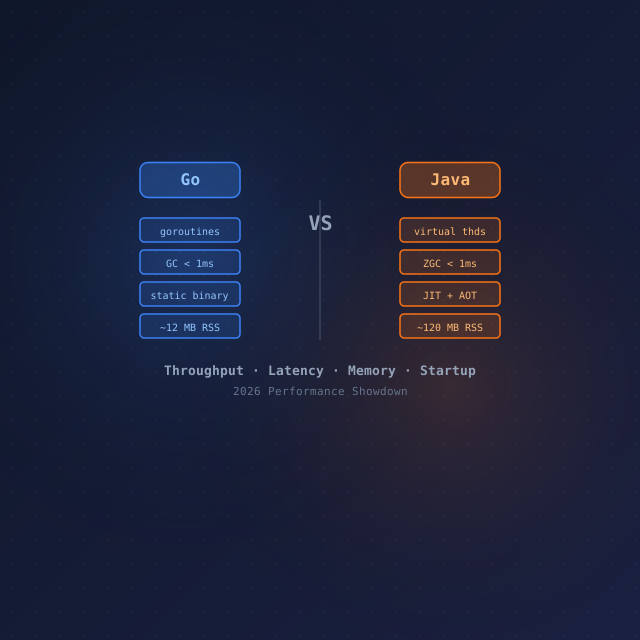
Go’s memory model is built around simplicity. The garbage collector is designed to scale with live heap size, and the runtime avoids heavy upfront memory commitments. This leads to a system where memory usage tends to reflect actual workload size rather than runtime overhead.
Java, even in modern versions, carries a more complex memory structure. The heap is explicitly sized, metadata must be tracked, class loading introduces overhead, and JIT compilation requires additional memory for optimized code storage. Even when a Java service is doing very little work, the runtime itself has a baseline cost.
This difference becomes critical when scaling horizontally. If each instance consumes more memory, fewer instances fit per machine, and infrastructure cost increases even if CPU usage is identical.
This is one of the few areas where Go maintains a consistent structural advantage.
Startup Time and Elastic Systems
Startup behavior is another area where the contrast is still very visible.
A Go service starts almost instantly. There is no runtime warmup phase, no class loading, and no dependency injection initialization. The binary becomes ready to serve traffic within milliseconds.
Java behaves differently. Even with modern improvements like CDS, AOT compilation, and virtual threads, a typical Spring Boot service still goes through a complex startup sequence. It builds an application context, initializes dependencies, warms up internal caches, and relies on JIT compilation over time to reach peak performance.
This difference matters most in elastic environments. Serverless systems, autoscaling groups, and burst-heavy workloads all benefit from fast startup times. Go fits naturally into these environments.
Java can compete in this space using GraalVM Native Image, but that approach shifts the trade-off by reducing runtime flexibility and peak optimization potential.
Latency Behavior: Why Tail Latency Matters More Than Average Speed
In backend systems, average latency is often misleading. What actually impacts users is tail latency—the slowest responses under load.
Go achieves stable latency largely because its garbage collector is designed to minimize stop-the-world pauses. Most GC work happens concurrently with application execution, which leads to predictable performance even under stress.
Java’s situation is more nuanced. The default garbage collector (G1) is heavily optimized but can still produce noticeable pause spikes under certain conditions. This is where older “Java is slow” perceptions originate.
However, modern Java with ZGC changes this significantly. ZGC is designed specifically to eliminate long pause times by performing almost all GC work concurrently. In properly tuned systems, Java can achieve latency stability comparable to Go.
The key difference is that Go provides this behavior by default, while Java requires deliberate configuration and runtime selection.
Concurrency Models: Two Different Philosophies
Go’s concurrency model is simple and direct. Goroutines are cheap, lightweight, and managed by the runtime scheduler. This allows developers to write concurrent systems without thinking too much about thread management.
Java historically relied on heavy threads, which created scalability limitations. Virtual threads changed this completely by allowing blocking-style code to scale to massive concurrency levels without the traditional thread cost.
Despite this convergence, philosophical differences remain. Go encourages explicit simplicity in concurrency design. Java offers more flexibility and a richer ecosystem of concurrency tools, but at the cost of more complex tuning decisions in large systems.
Ecosystem Depth: Java’s Long-Term Advantage
While Go focuses on simplicity, Java’s biggest strength is its ecosystem maturity.
The Spring ecosystem alone provides a full-stack backend framework covering dependency injection, data access, security, messaging, and distributed system integration. Hibernate and JPA remain extremely powerful tools for complex relational data modeling.
Java also dominates in enterprise integration scenarios, where legacy systems, complex workflows, and large domain models require mature tooling.
Go’s ecosystem is lighter and more focused. It excels in cloud-native services, infrastructure tools, microservices, and systems where simplicity is more important than deep abstraction layers.
This difference often determines language choice more than performance ever will.
Operational Cost: The Hidden Impact of Memory Density
Infrastructure cost in modern cloud systems is often driven more by memory than CPU.
Because Go services typically require less memory per instance, they allow higher container density per node. This directly reduces infrastructure costs in large-scale deployments.
Java services can be optimized, but they generally start from a higher memory baseline due to runtime overhead. Even when CPU usage is similar, fewer Java instances fit on the same hardware.
However, this gap is not absolute. JVM tuning, heap optimization, and Native Image compilation can significantly reduce memory usage. But achieving that requires intentional engineering effort.
Go achieves low memory usage by design rather than configuration.
The Biggest Engineering Mistake: Wrong Benchmarks
One of the most common mistakes teams make is choosing a language based on synthetic benchmarks.
Microbenchmarks often measure isolated operations like JSON encoding, in-memory loops, or empty HTTP handlers. These tests ignore the real bottlenecks of backend systems.
In real production services, performance is dominated by external systems: databases, caches, APIs, and network latency. Once those are included, differences between Go and Java shrink dramatically.
This is why many rewrite decisions fail. The bottleneck was never the language runtime—it was system architecture.
When Go Is the Better Choice
Go becomes the stronger option when the system prioritizes operational simplicity, low memory usage, fast startup, and predictable performance without heavy tuning.
It fits especially well in cloud-native environments, microservices architectures, and infrastructure tooling where deployment speed and density matter.
Go also reduces cognitive overhead for teams, which can improve long-term maintainability in large distributed systems.
When Java Is the Better Choice
Java is the stronger choice when systems require deep domain modeling, complex business logic, mature frameworks, or long-term enterprise integration.
It excels in environments where rich abstractions, large codebases, and complex transactional workflows are central to the system.
Java also becomes extremely competitive in latency-sensitive systems when paired with ZGC and modern runtime configurations.
Final Reality Check
By 2026, the idea that one of these languages is universally faster is no longer true in meaningful backend workloads.
They are both capable of high performance. They both scale. They both handle concurrency well. The differences are no longer about raw speed, but about system design trade-offs.
Go reduces complexity and memory usage. Java increases ecosystem power and structural flexibility.
The correct choice depends less on benchmarks and more on the shape of the system you are building.
In modern backend engineering, the runtime is no longer the bottleneck. The architecture is.